
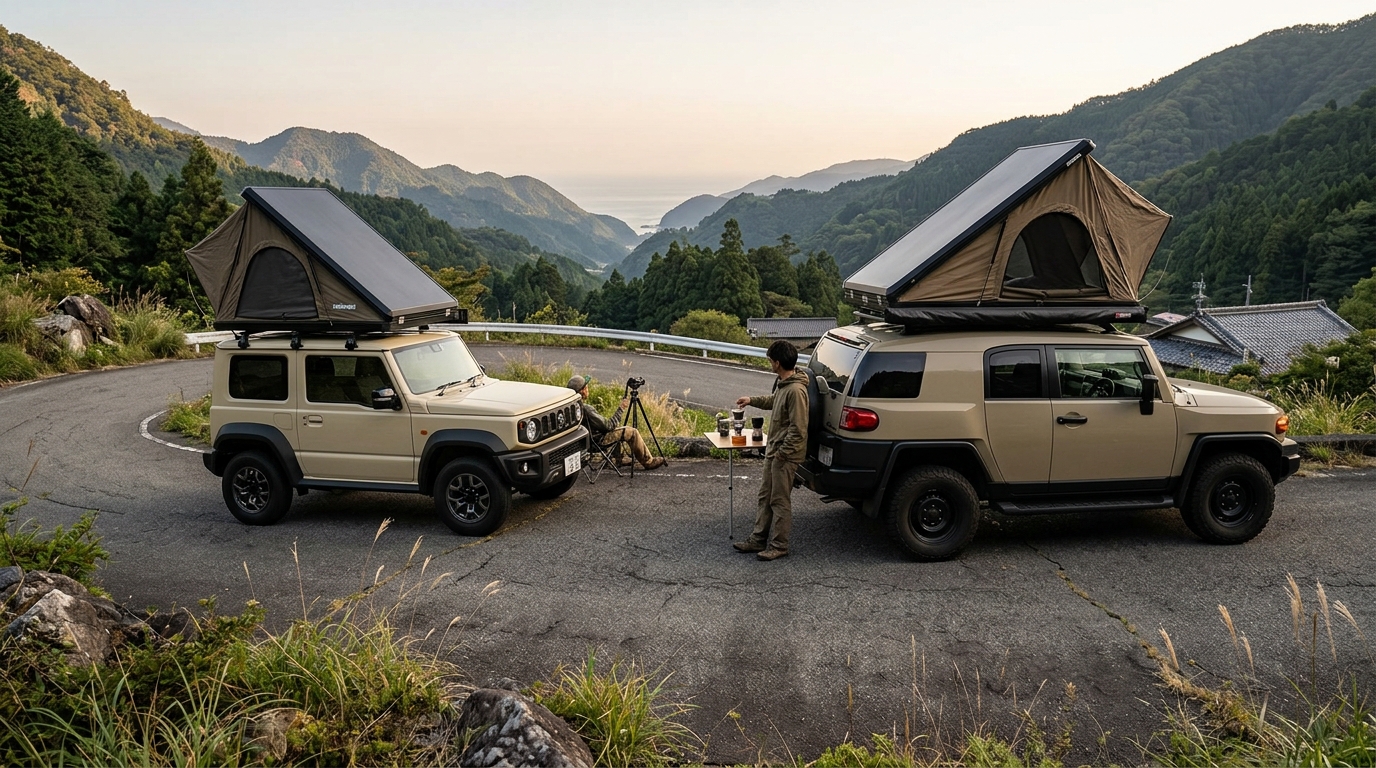
Choosing the right overland vehicle in Japan defines the entire character of your journey. Overland Campers Japan hosts a diverse fleet, but the decision often narrows down to two distinct philosophies: the nimble Suzuki Jimny Sierra and the robust Toyota FJ Cruiser. According to recent industry data on compact 4x4 sales, the Jimny has become a global phenomenon due to its boxy design and serious off-road credentials packed into a tiny footprint. Meanwhile, the FJ Cruiser remains the gold standard for those prioritizing interior volume and long-distance highway comfort. Understanding the mechanical and logistical differences between these two platforms is essential for planning a safe and enjoyable trip across Japan's varied terrain.
Core Differences in Design and Capability
The fundamental divide between these two vehicles lies in their intended purpose. The Suzuki Jimny Sierra is engineered as a compact, lightweight explorer. Its short wheelbase and low center of gravity allow it to navigate narrow mountain passes and tight rural roads that larger vehicles simply cannot access. In contrast, the Toyota FJ Cruiser is a mid-size SUV designed for durability and passenger comfort. It offers a more traditional SUV driving experience with greater stability at high speeds and significantly more interior space for luggage and gear.
Both vehicles are fully equipped with rooftop tents, kitchen setups, and power systems, ensuring that neither compromises on the camping experience. However, the Jimny requires a more active approach to driving, while the FJ Cruiser allows for a more relaxed pace. The choice depends largely on whether you prioritize technical off-road access or spacious comfort.
The Suzuki Jimny Sierra: Agility and Access
The Suzuki Jimny Sierra is a legend in the overlanding community. Its compact 4x4 design makes it incredibly maneuverable. This vehicle is ideal for travelers who want to explore hidden gems, narrow coastal roads, and steep forest trails. The Jimny's ability to climb steep gradients and traverse rough terrain is exceptional for its size. It is a two-seater vehicle, which means the focus is entirely on the driver and one passenger sharing the adventure.
One of the most significant advantages of the Jimny is its accessibility. Because of its small dimensions, it can fit into tight parking spaces and narrow lanes in rural Japan. This is particularly useful when visiting popular shrines or remote hot springs where larger vehicles are prohibited. The Jimny is available in several distinct color variants, including the iconic Martini, Surf, and classic Black or White finishes. Each vehicle is prepared with a complete overland setup, including a rooftop tent for stargazing and a compact kitchen for meal preparation.
Driving a Jimny requires a different mindset. It is not a highway cruiser. While it can handle expressways, the focus is on the journey rather than the speed. The suspension is tuned for off-road capability, which means you will feel more of the road texture. This is a trade-off for its incredible traction and climbing ability. For couples or solo travelers willing to embrace a more rugged experience, the Jimny offers unmatched access to Japan's wilder landscapes.
The Toyota FJ Cruiser: Space and Comfort
The Toyota FJ Cruiser represents the pinnacle of rugged comfort. Designed with a retro aesthetic but modern engineering, this vehicle offers a spacious interior that can comfortably seat two adults with ample room for luggage. The FJ Cruiser is built on a body-on-frame chassis, providing superior durability and safety on long journeys. It is equipped with a powerful engine that handles highway speeds with ease, making it an excellent choice for travelers covering long distances between regions.
Interior space is the primary differentiator. The FJ Cruiser allows for more extensive gear storage, which is crucial for longer expeditions or those who prefer to travel with more comfort items. The rooftop tent setup is integrated seamlessly, providing a secure and comfortable sleeping platform. The vehicle's wider stance and longer wheelbase offer greater stability on winding mountain roads, reducing the feeling of being "tippy" that can sometimes occur in smaller SUVs.
The FJ Cruiser is also known for its reliability. Toyota's reputation for building vehicles that can withstand harsh conditions is well-deserved. This makes it a safe choice for remote travel where breakdowns could be problematic. The vehicle is available in Gray and Black variants, each meticulously maintained to ensure peak performance. For travelers who value a balance of off-road capability and on-road comfort, the FJ Cruiser is the superior option.
Vehicle Specification Comparison
The following table summarizes the key differences between the Suzuki Jimny Sierra and the Toyota FJ Cruiser to help you make an informed decision.
| Feature | Suzuki Jimny Sierra | Toyota FJ Cruiser |
|---|---|---|
| Seating Capacity | 2 Passengers | 2+ Passengers |
| Vehicle Size | Compact (Small Footprint) | Mid-Size SUV |
| Off-Road Capability | Extreme (High Maneuverability) | High (Robust Durability) |
| Highway Comfort | Moderate | Excellent |
| Luggage Space | 80 cm x 60 cm x 80 cm | Spacious Interior |
| Transmission | Automatic | Automatic |
| Best For | Narrow Trails & Tight Spaces | Long Distances & Comfort |
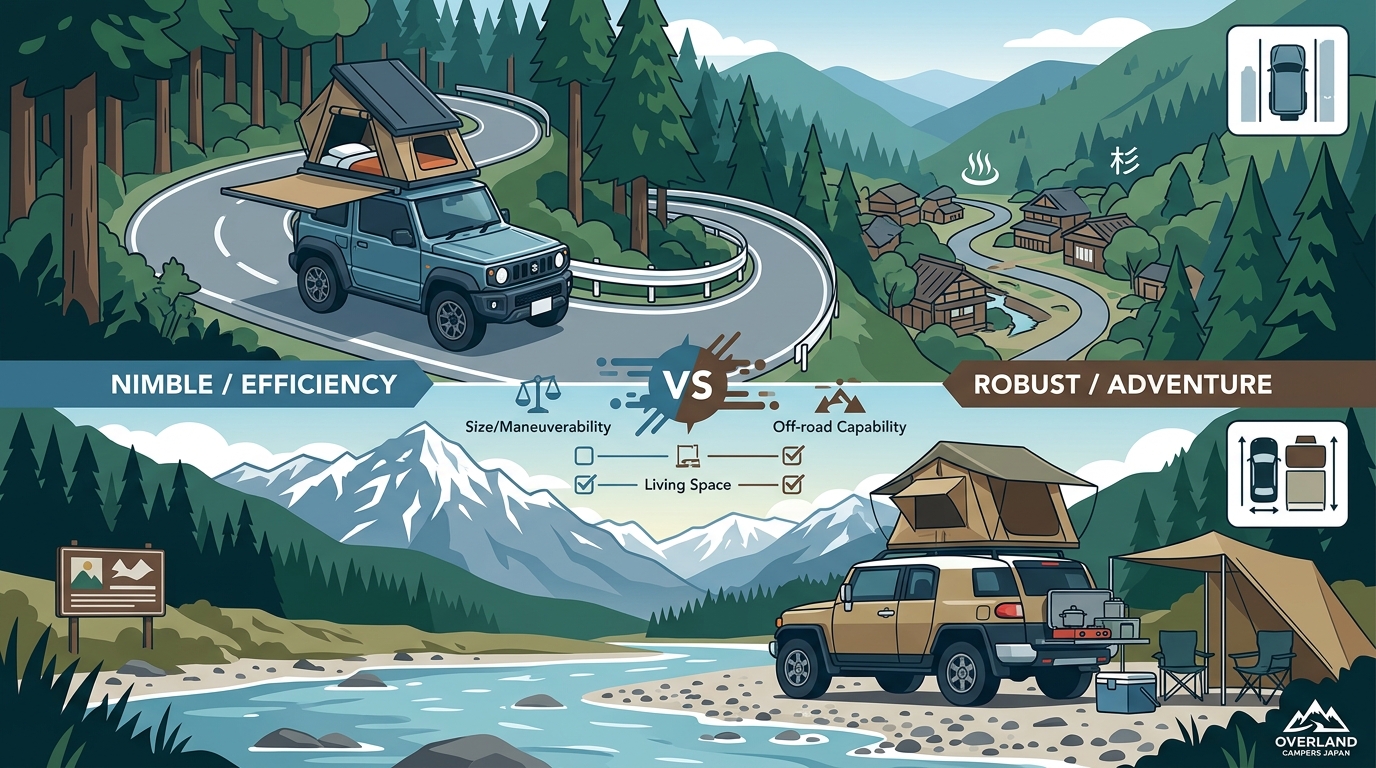
Matching Vehicles to Japanese Itineraries
Your choice of vehicle should align with your planned itinerary. If your trip focuses on the Japanese Alps, the Tohoku region, or the rugged coastlines of Kyushu, the Suzuki Jimny Sierra is often the preferred choice. Its ability to climb steep, narrow roads and access remote campsites is unparalleled. For example, exploring the mountainous regions of Japan is significantly easier with a vehicle that can navigate tight switchbacks.
Conversely, if your itinerary involves long drives between Tokyo and Fukuoka, or a comprehensive tour of the main islands, the Toyota FJ Cruiser provides the necessary comfort and range. The additional interior space allows for more frequent stops and easier organization of gear. Travelers who plan to visit multiple national parks and require more equipment will find the FJ Cruiser more practical. The Fukuoka base offers easy access to Kyushu's diverse landscapes, where the FJ Cruiser's stability is a major advantage.
It is also worth noting that both vehicles are available for one-way drop-offs. You can pick up a Jimny in Tokyo and drop it off in Fukuoka, or vice versa. This flexibility allows you to design a linear route without backtracking. The Tokyo base is conveniently located near Shibuya and Shinjuku, making it easy to start your journey immediately after arriving in the city.
Key Takeaways
- The Suzuki Jimny Sierra is a compact 4x4 designed for two passengers, offering extreme off-road maneuverability in tight spaces.
- The Toyota FJ Cruiser provides a mid-size SUV experience with greater interior space and highway comfort for long-distance travel.
- Both vehicles come fully equipped with rooftop tents, kitchen gear, and power systems, requiring no additional upgrades.
- The Jimny is ideal for exploring narrow mountain trails and remote coastal roads in Japan.
- The FJ Cruiser is better suited for travelers prioritizing luggage space and comfortable highway driving.
- Overland Campers Japan operates from two main bases: Tokyo and Fukuoka, allowing for flexible one-way rentals.
- Both vehicles feature automatic transmission and are available in multiple color variants to suit personal preference.
Frequently Asked Questions
Can I drive the Suzuki Jimny on Japanese expressways?
Yes, the Suzuki Jimny can drive on expressways, but it is not designed for high-speed cruising. It is best used for accessing destinations via local roads. For long highway stretches, the FJ Cruiser offers a more comfortable and stable experience.
What is the luggage capacity of the Jimny?
The Suzuki Jimny Sierra has a compact luggage area measuring approximately 80 cm x 60 cm x 80 cm. This is sufficient for two people traveling light. The FJ Cruiser offers significantly more interior space for larger gear.
Are the vehicles fully equipped for camping?
Absolutely. Every vehicle, whether a Jimny or an FJ Cruiser, comes with a complete overland setup. This includes a rooftop tent, kitchen equipment, power supply, and premium camping gear. There are no hidden extras or required upgrades.
Can I pick up a camper in Tokyo and drop it off in Fukuoka?
Yes, Overland Campers Japan offers one-way drop-offs. You can pick up your vehicle at the Tokyo base and return it at the Fukuoka base, or vice versa, allowing for a seamless cross-country journey.
What is the cancellation policy for camper rentals?
Cancellations must follow the specific terms outlined in the rental agreement. Generally, payments are processed via bank transfer or credit card, and reservations are confirmed upon payment clearance. Late cancellations may incur fees.
Do I need a special license to drive these 4x4s?
A standard driver's license is sufficient for renting these vehicles. However, international visitors must ensure they have a valid International Driving Permit alongside their home license to drive legally in Japan.
How long does the vehicle handover process take?
The handover process typically takes about 30 to 40 minutes. This includes a thorough walkthrough of the camper's features, safety instructions, and contract signing. It is important to arrive on time to ensure a smooth start to your trip.
Book Your Adventure
Whether you choose the agile Suzuki Jimny Sierra or the spacious Toyota FJ Cruiser, you are guaranteed an unforgettable experience exploring Japan. Both vehicles are meticulously prepared to provide a premium camping experience. Book your camper rental today and secure your dates for an unscripted adventure across Japan's most beautiful landscapes. Contact the team at Overland Campers Japan for personalized advice on which vehicle best fits your itinerary.